
In Passing: Delta Pays Tribute to Acclaimed Wildlife Artist
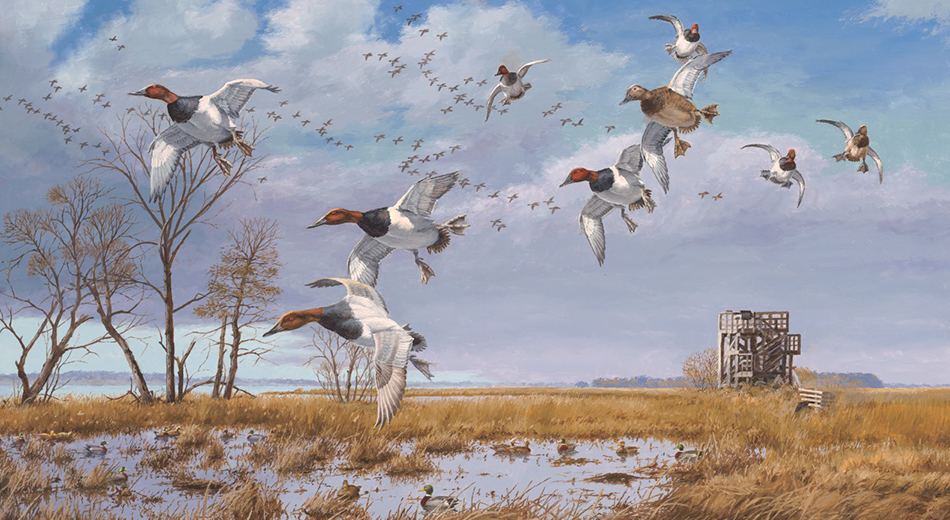
Study a David A. Maass waterfowl painting, and you’ll find yourself immersed in a windswept marsh, eye to eye with a flock of rushing canvasbacks as the north winds of November tear at your face. You’ll hear a whoosh of wings as mallards whisk past or the raucous honks of migrating geese frozen in time by the tip of the master artist’s paintbrush.
Maass, a widely admired artist — and longtime friend to Delta Waterfowl and wildlife conservation — who depicted incredibly realistic waterfowl and wildlife scenes, died April 29. He was 96.
Born into the outdoor sporting lifestyle, Maass grew up in Minnesota with important parental role models. His mother, Ora, was a state trap-shooting champion, while his stepfather, Kelly, served as an enthusiastic hunting mentor. As a boy, David spent many hours observing and sketching wildlife and nature.
Even without formal instruction as an artist, Maass landed a job at Jostens and soon became an art director for the memorabilia company. After serving in the U.S. Marine Corps in California, Maass returned to Minnesota in 1964 to pursue art full time.
During his decorated career, Maass proudly produced hundreds of paintings which helped raise millions of dollars for conservation work throughout North America.
He painted 38 waterfowl and conservation stamps, including winning the prestigious Federal Duck Stamp Art Competition twice. His wood duck painting was featured on the 1974-75 stamp and a trio of canvasbacks over a stormy marsh graced the 1982-83 stamp.
“David Maass was one of the kindest and finest gentleman I knew, and his artwork, whether it was a print at a local fundraising event, the Federal Duck Stamp or various other stamps, had an indelible impact on waterfowl and other forms of conservation,” said John Devney, Delta’s chief policy officer. “Maass will be fondly remembered and forever memorialized by Delta and duck hunters across the continent.”
During a 2021 interview, Maass revealed that inspiration for many of his paintings, especially scenes featuring canvasbacks, were fueled by visits to the Delta Marsh in Manitoba. Maass hunted with famed outdoor writer Jimmy Robinson at the Sports Afield Duck Club annually beginning in 1975.
 “It’s just the perfect duck marsh,” Maass said about the 40,000-acre Delta Marsh. “I’ve seen it when it’s good. I’ve seen it when it’s bad. It’s just everything to me. I’ve done more paintings of the Delta Marsh than any other area.”
Naturally, Maass became familiar with the Delta Waterfowl and Wetlands Research Station on the north end of the Delta Marsh. Soon, he developed friendships with Delta Waterfowl staff members.
In 1998, Maass painted Delta Waterfowl’s iconic canvasback head logo, which served as the organization’s primary brand mark for two decades.
In 2021, then age 91, Maass painted a special scene set at Manitoba’s Delta Marsh as a special work for inclusion in the Delta Waterfowl history book. “Action Over Delta Research Station” was one of his final paintings — a marvelously fitting work featuring a flock of canvasbacks settling into his favorite marsh. — Paul Wait