
How to Build, Install and Maintain Your Hen House
Materials
• Flax straw (1 50-pound square bale usually makes 5-7 tunnels)
• If flax is not be available in your area, then substitute with the most durable grass or straw you can find. Wheat and barley straw are too light and don’t work well.
• Use grass hay for nesting material. Delta has had success with brome hay and other grasses. In Minnesota and South Dakota, flax works well for both the exterior and nest material.
• 8-foot long base pipe (1.5” square tubing)
• 30-inch long adjustable insert pipe (1” square tubing)
• 18-inch long cradle support pipe (1” square tubing)
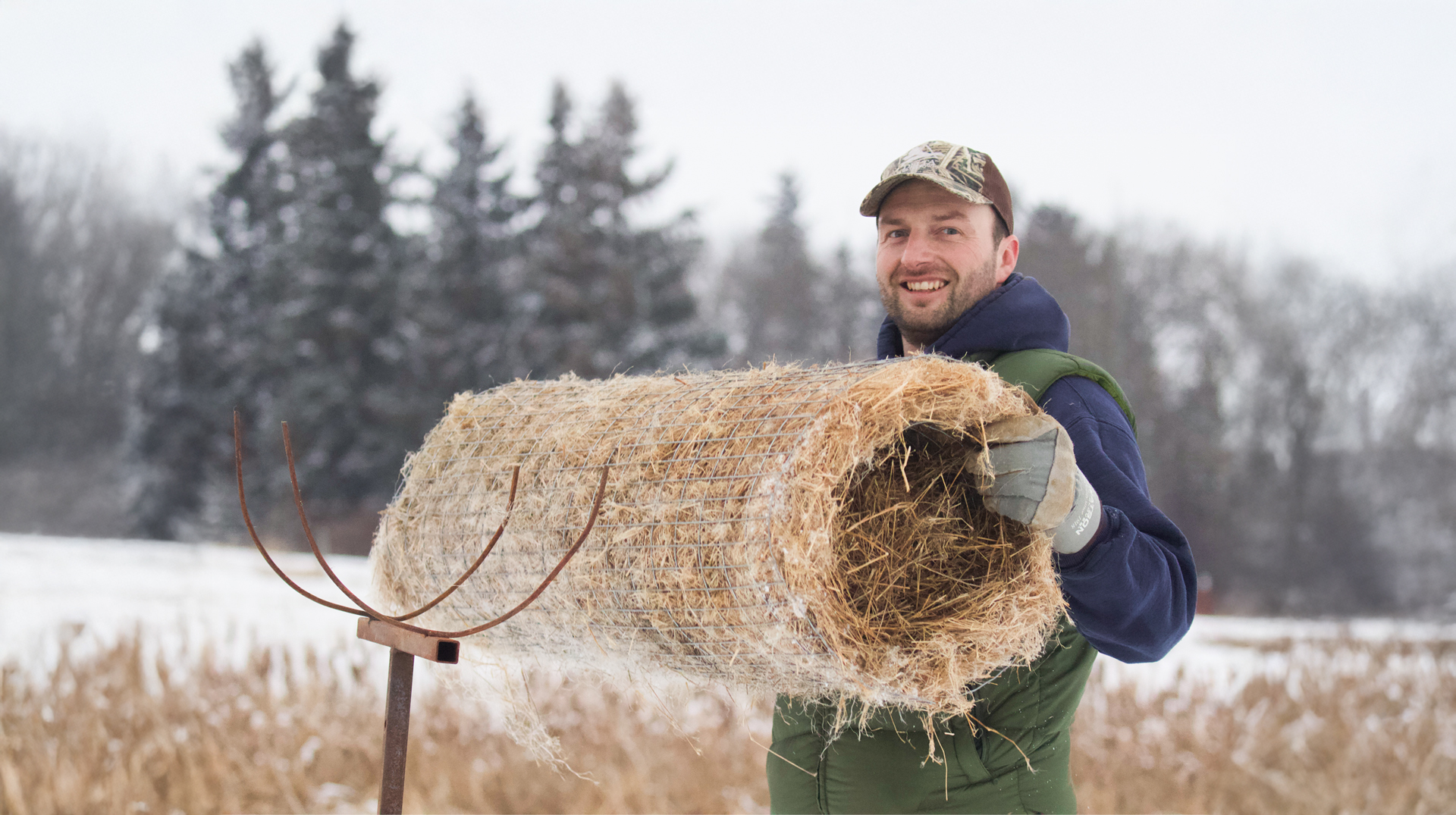
• 7’x3’ section of welded wire fencing (2” by 1” mesh with 14 gauge wire) – this is double rolled with flax to form the Hen House
• Wire must be firm to prevent tunnel from bending (i.e., no “chicken wire”)
• Two 20-inch lengths of ¼” steel rod, bent to form cradle
• 12 hog rings and 1 bolt or wire-lock pin to attach insert to post
Total cost will vary with location, steel prices and quantity purchased.
Steps for Assembly
1. Drill two to three equally spaced holes along the 30” insert pipe for height adjustment. Then drill one hole in base pipe about 8” from the end.
2. Weld insert pipe to the 18” cradle support pipe, midway along. This will form a T.
3. Bend ¼” rod pieces into semi-circles. Then weld one at each end of cradle support pipe.
4. Roll up three feet at one end of 7’x3’ wire fencing and hog ring in 3-4 places to form an inner tunnel.
5. Spread approximately 2” of flax straw (or equivalent) on remaining 4’ of fencing, then continue to roll tightly. Hog ring end of fencing to complete the Hen House, providing an 11-12” diameter opening on each end. Try not to exceed 12” as Canada geese may use larger Hen Houses.
Steps for Maintenance
1. Revisit every year a month or two prior to the nesting season.
2. Check for and record nesting activity from the previous year. Look for a nest bowl with down, egg fragments, egg membranes, or whole eggs.
3. Repair exterior by replacing missing flax straw. Hens often remove straw and add to nest bowl.
4. Remove old nest remains and add new grass to the inside of the tunnel. Make sure Hen House is one-half to two-thirds full of grass.
Stay Up To Date With Delta Waterfowl
Wisconsin Sandhill Crane Season Makes Progress, But Falls Short as Legislative Session Ends
3/27/2026
Authority to establish hunting season passes State Assembly, stalls in Senate
Read more
Delta Waterfowl Forms Planned Giving Department to Deliver More for Ducks and Duck Hunters
3/25/2026
Benson, Shields will lead new initiative to increase philanthropic impact
Read more
Farm Bill Introduced, New Conservation Funding Mechanisms and Firearm Discharge By-Laws
3/24/2026
Delta-backed legislation continues to receive support across the continent
Read more